What is Digital Marketing? The Ultimate Guide for Businesses
Digital marketing has become the pillar of modern business development. It is not necessary whether you are running a high-end business, a small bakery, or an online store. It’s very common these days that most of your customers are online, and your brand's online presence is also very important.
Here, you will get to know what exactly digital marketing is. And why is this so important these days? What are the fundamental marketing strategies, and how can you implement them in your company? Because you need to employ a combination of techniques most of the time.
At the end, we will discuss the way businesses are being altered by artificial intelligence (AI) nowadays.
What is digital marketing?
Digital marketing is basically the name of advertising companies, goods, or services online, and to promote these the one uses search engines, email, social media, mobile applications, websites, and other platforms. And that is what we call digital marketing.

Traditional marketing has become an old trend now. Now is the era of digital marketing. These companies need to engage the audience and for that it uses data, automation, and interactivity to move traditional marketing into the digital sphere. Websites, apps, mobile devices, social media, search engines, and other digital means" to increase engagement and sales, according to Investopedia.
Importance of Digital Marketing
Ignoring digital marketing will result in a loss of market share to rivals that use it in today's digital-first economy. Here's why it's so important:
Scale and Reach:
Regardless of how local or international your business is, digital channels actually allow you to reach customers far beyond your physical location. You have more choices than just local media and foot traffic. A local café can use promotional strategy on Instagram to attract local clients, and a fashion firm might use e-commerce ads to reach buyers abroad.
Cost Efficiency & ROI Tracking:
This is another benefit for you that online campaigns are actually less expensive than other advertisement sources like print, outdoor ads and TV. Additionally, you can also monitor each click, conversion rate, and money spent in real time. Because all these will help you to identify what is and is working for your business and what is not.
Targeting and Customization:
Demographic, geographic, psychographic, and behavioral traits are part of the data and analytics that would be used to categorize your audience into groups according to their age, location, behavior, hobbies, and any other criteria required. This will actually help you to design your business message more appropriately and relevant for your audience. As a result, your lead's engagement and conversion rate will rise.
Results tracking:
Measurable outcomes at every level are the biggest benefit of moving your business online. Google Analytics, Facebook Insights, and marketing automation dashboards will display data such as the number of visitors, buyers, and impressions on your website. This way you can improve your campaigns, like how to manage the duration, the content to see if they are attracting the customers or not, and also forecast the upcoming campaigns, like on special occasions.
Enhanced Engagement & Experience for Customers:
Email, WhatsApp, or Instagram chat, and all other social media platforms facilitate a two-way connection. Direct communication with consumers through reviews, chats, direct messages, comments, and surveys is encouraged by digital marketing, which would surely strengthen consumer loyalty and confidence with your brand.
Flexibility & Competitiveness:
With the help of local SEO, evidence of your brand’s credibility among consumers, and creative content, even startups can rank among the industry leaders. Additionally, unlike a fixed billboard ad, campaigns can be rapidly adjusted based on performance.
Types of digital marketing
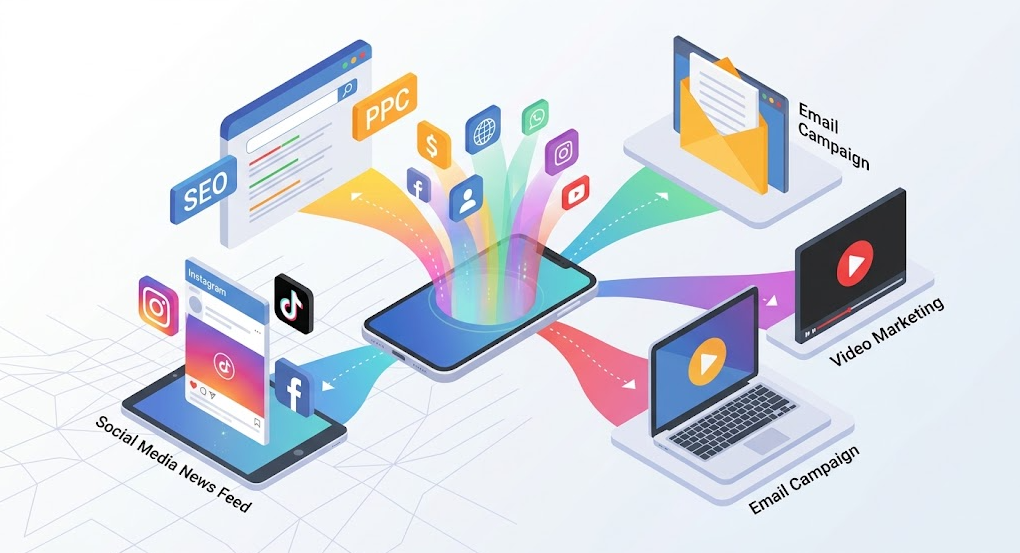
Digital marketing is a multi-channel, wide-ranging field. Here we are discussing all the major types of digital marketing with real time examples.
1. SEO or search engine optimization:
SEO is the process of making your website and content better so that it appears higher in organic (non-paid) search results. More people will visit your website if your page is ranked higher by Google.
- On-page SEO is the process of keeping improving your website's content, keywords, speed, and structure.
- Off-page SEO refers to establishing credibility and trust about your brand, such as trustworthy backlinks and posts, and brand mentions.
Technical SEO means the technical elements of your website, such as the infrastructure and backend coding. Make it so that search engines may crawl it and rank it.
- Local SEO will make your business display in local maps and searches.
Example: Ranking for "best parlor near me" on Google Maps, a parlor in Lahore may attract more local customers.
Because SEO is a long-term strategy, you could never see benefits right away. Although it can take a while, it will eventually pay off and bring in steady traffic.
2. Search Engine Marketing (SEM) and Paid Search (PPC):
As the term suggests, search engine marketing (SEM) refers to the price you might pay to have your website appear in search results. Usually, Pay-Per-Click (PPC) advertisements are used. You pay the cost of a keyword bid when someone clicks on your advertisement.
- How SEM operates:
You select your target keywords that would be relevant to what you are offering.
Make landing pages and ad copy.
See your budget, then decide what you can pay for the bid.
Track everything necessary, like sales, cost per click, and ad clicks, then make adjustments accordingly.
SEM provides your website with instant traffic and quick visibility. Basically, with SEM, you can launch your brand today and start receiving clicks tomorrow, unlike SEO, which will take longer.
Example: The Google Ads campaign for a clothing brand will immediately place the phrase "buy men's jackets online" above organic results.
3. Marketing on Social Media (SMM):
When you promote your brand or content on social media sites like Facebook, Instagram, TikTok, LinkedIn, Twitter, and others is known as social media marketing. It covers both paid and organic tactics.
- Organic SMM: Share your content’s behind-the-scenes, feedback from customers, funny memes, informational reels, and stories.
- Paid SMM: Influencers market your company, sponsored advertisements are paid promotions, and retargeting serves as a reminder.
Example: A restaurant uses Instagram advertisements that offer discount coupons and videos of their chef’s behind-the-scenes for attracting more customers.
4. Content Promotion:
Content marketing makes up the majority of digital strategies. Make sure that your content is HD quality and useful for viewers. This way you can maintain your audience. Whether it's for learning, fun purpose or problem-solving.
Formats consist of:
- Articles and blogs
- Case studies and guides
- Webinars and videos
- Visual content and infographics
- Podcasts
Example: A medical company uses blog posts like "10 Medical Myths You Need to Stop Believing" to draw clients and demonstrate the validity of their brand.
5. Email marketing:
One of the most effective ways to get a return on investment. Email your customers for upcoming deals, updates, and campaigns.
Example: An online retailer sends them emails that the first 50 customers will get 40 % off.
6. Influencer and Affiliate Marketing:
An individual, referred to as an affiliate, receives a commission for endorsing the goods or services of another business through the performance-based marketing model of affiliate marketing.
There are similarities in influencer marketing. You work with creators who have a loyal fan base and a large audience.
They make it possible for you to establish genuine connections with new audiences.
Example: A fitness blogger markets their protein supplements using affiliate links in order to profit from each sale.
Example: A fitness blogger uses affiliate links to market their protein supplements and, in return, make money on each purchase.
7. Video Promotion:
Obviously visual representation of brands attracts more people. You can upload useful content on Facebook, Instagram, Pinterest, TikTok, and YouTube.
Use cases:
- Videos that explain your products or services.
- Guidelines and demonstrations
- Some behind-the-scenes videos
- Case studies and testimonials
- Live streaming
Example: A skincare brand can increase its traffic by sharing videos of its most well-liked products and their results by showing screen shorts and videos by trusted customers.
8. App and Mobile Marketing:
Using text messages, app alerts, in-app ads, and mobile-friendly websites on mobile devices is another method to expand the number of clients you serve.
Example: A restaurant at lunchtime sends you a notification for food delivery, says, "Hungry? Save 20% on purchase!
9. PR & Reputation Management Online:
Digital PR actually concentrates on online mentions, your brand publicity, press releases, and influencer endorsements; in fact, it’s much like the conventional PR done on media. You can maintain your brand’s reputation by seeing how the customers respond and also by brand references.
Things to consider:
- Keeping an eye on brand mentions
- Promoting and regulating client testimonials
- Handle the complaints online.
- Collaborations with blogs and journals
Example: A health care company monitors reviews on its products, responds to comments, and publishes reviews from guests on its website.
10. Marketing Automation:
Marketing automations is the name of posting the same content again, sending the emails with automation tools like HubSpot, Mailchimp, and ActiveCampaign. This can save time and will boost your productivity.
Example: A 20 days’ welcome email series will be automatically sent to new members by an online retailer.
11. Conversion Rate (CRO) Optimization:
Change the design of your site according to the response. This way, you can increase your visitors.
Example: XYZ, an online learning platform, tests two distinct landing page headlines to see on which page the more visitors come and sign up for their site.
12. Voice Search & Smart Device Marketing:
Google Assistant, Alexa, and Siri are common nowadays. So voice search optimization is also getting popular. So you have to update your business with this.
Example: A pizza place optimizes for voice searches like "order pizza near me."
How AI is affecting Digital Marketing
Artificial intelligence (AI) is causing a rapid change in digital marketing. Because it has improved the speed, intelligence, and customization of everything. AI can also handle customer service to analyze and forecast customer behavior. Artificial intelligence (AI) is helping new businesses in precisely optimizing marketing based on data.
Here are a few ways AI is influencing the future:
- AI can analyze the user’s interests and hobbies and display them the products and services they are interested in.
- Chatbots and virtual assistants are offering 24-hour, continuous, and on-the-spot service.
- Predictive analytics will help you in precisely predicting the consumer’s behaviors and new trends.
- Content Creation is the main thing, and AI thoroughly helps you in this. AI can write product descriptions, articles, advertisements, blogs, and can also produce images as per your requirements.
- Ads are shown to the right individuals and at the best time. Thanks to ad targeting.
- You can automate repeated operations, such as email marketing, that would save your time.
- Improved Insights are also provided by AI. It can quickly evaluate large data to provide you with the best choice.
FAQS
1. When did digital marketing start?
When the internet became widely available in the 1990s, digital marketing got its start. Social media platforms launched search engines like Yahoo (1994) and Google (1998) in the early 2000s.
2. Is digital marketing hard?
Digital marketing is not as hard to understand as we think. You have to be creative. Go with the latest trends and technology. Never stop learning new things.
3. What is attribution in digital marketing?
Attribution in digital marketing means to analyze the customer’s reaction to determine whether they buy or sign up. For example, a customer is buying or availing a service after clicking on an email, seeing a Facebook ad, or by reading a blog? This way the marketers can understand where to spend money and efforts to get the highest results.